
Scientific and technical periodicals were the first type of printed publication to be effectively digitised en masse. The roots of this tecnologisation of the periodical literature grew before the widesperead use of personal computers. MEDLARSand the Science Citation Index started in 1964 and although this early surge of database activity focussed on abstracts and indexing, by the time the web was invented 33 years ago, many scientific periodicals were well on the way to being fully computerised, databased and distributed to libraries and readers.
The resulting market has been highly profitable for the biggest commercial players (Elsevier, Springer-Nature, Wiley et al). One consequence of the way that this digitisation has taken place is that the ‘scientific periodical’ had been pretty much ‘disintermediated’. The separate publications are aggregated into a database of articles and sold as substantial and pricey bundles. The printed ‘magazines’ in many cases still exist, but as a physical resource they have shrunk to nothingness. Simply binders. The scientific periodical has become a refereed repository for articles. No more advertisements, fewer informal communications, book reviews will not be needed, illustrations may be plentiful but they will be the responsibility of the authors or contributors of the individual papers, not of the editor or the publisher. The articles still appear in a periodical order (within an issue, alongside fellow articles, published in June 2025 etc) but from the point of view of the reader, the librarian, the referee, or the fellow scientist the articles are what matters. The date of submission or acceptance of the article will probably of greater interest than the date of publication.

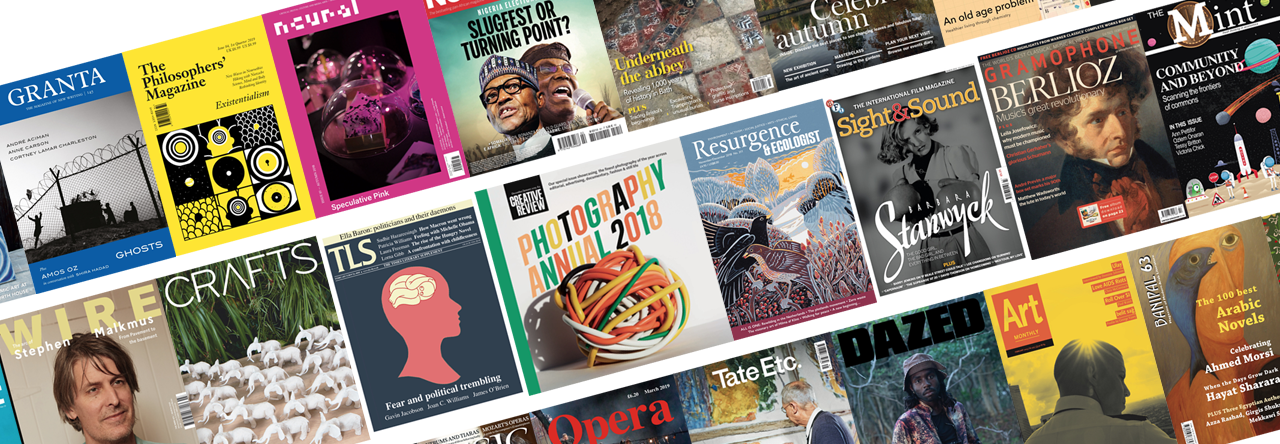
It is striking and obvious that cultural, professional, artistic and popular magazines have not migrated to digital and databased repositories in the same disintermediated way. Popular, professional and cultural magazines of the kind that are of interest to Exact Editions (or might be interested in using the Exact Editions platform), are quite different. In most cases, the front cover will be a central focus, tables of contents may be richly illustrated, correspondence may be encouraged. The whole issue is likely to be browsed by readers just as key articles are read, and perhaps re-read. The editor’s and the designer’s footprints, or better her detailed nudging and discrete adjustment, will be seen on every page. And the layout of the pages is still very important. This visual distinction, often design excellence, remains a core value, a mark of the individuality of the magazine.
Did I just write ‘magazine’ or should I really have commended the ‘individuality of the digital periodical’? This is a good question, because one of the happy consequences of the digitisation of magazines is that their periodicality becomes even more important and leads us to much easier and deeper forms of magazine browsing. With deep archives, as in the case of magazines which have endured for decades, or longer, in print and digital format, the full archive reproduced and fully searchable with database tools becomes a much more browsable resources. Browsable, and, thanks to the immediate rapidity of search and the ease of flipping between decades, back and forth between widely separated issues, the whole resource gives the reader a more intimate and immediate experience of the magazine. And of its transition through time.

The temporal ordering of digital magazine content is also very useful when combined with searches which can be requested for ‘newest’ or ‘oldest’. A search for the earliest occurrence of ‘Menuhin’ in Gramophone will not only give us information about the earliest impact of a great violinist, it will also and incidentally give us the context of the way in which he was noticed and reviewed by the musical public. The context emerges with the early references and the way the ‘hits’ quickly thicken up as his genius is recognsed.

Browsing the new issue of a magazine is possibly the most common and familiar form of interacting with a print magazine — whether delivered through the post or bought from a kiosk. Browsing of digital magazines: front covers, tables of contents, reviews, advertisemets etc. is perhaps even easier and more natural. The availability of deep browsing through all or any of the back issues, or hits thrown up by a search, can be very fast and informative. More informative amd more contextual than simple ‘word search’.
I think this may also be telling us something about the way digital magazines will be used in a post-AI world. Magazines will always have charm, reliability and relevance when their reputation is rooted in an archive and a journal of record which connects us with earlier digital expectations and pre-digital print inheritance. Menuhin burst on the musical scene shortly after the magazine Gramophone was founded (1923). Gramophone arrived, and was seen to be necessary, because mechanical and soon electronic recording of sound was feasible. Gramophone will carry its focus and concern with quality into a new digital era — precisely because it holds and shows us the news and the opinions of recorded music over the last 100 years. The archive becomes more relevant and more potent in a cultural millieu which may be much more rapidly evolving and which will demand close knowledge and insight as to what has gone before. The editorial challenge for Gramophone is to keep the focus on the musical recording that needs to be noticed and heard. The technological challenge for the publisher is to make the content and the standards of the community ‘front of mind’ in a periodical rhythm which connects the past with the future. AI and alternative or augmented reality also needs time and tradition.
The type of deep browsing and comprehensive searching that is practical with fully digital magazines has two advantages for the digital-first magazine publisher. The title may occupy a niche, and this is the case for many of the magazines that are on the Exact Editions platform, but the niche becomes more compelling and useful to its primary audience as each new issue accumulates within the archive. So archives are growing and forward-looking just as much as they preserve the past. The second advantage is that magazine publishers with a common approach to preserving and enhancing the use of deep archives, stand stronger together. This is especially and most obviously the case when it comes to selling recurrent and long term subscriptions to libraries. A standard approach to licensing, searching, meta-data and accessibility is increasingly a necessity for magazines that have a market with libraries and educational institutions — and as the example of Elsevier, Wiley etc has shown — libraries need periodicals and they have to be digital to be useful in the 21st century.
Magazines with deep historical archives are perhaps better able to tackle a new technological landscape than has been recognised by the consumer magazine industry, with its b2c mindset. Nor is it surprising that AI developers have been keen to license the archives when they are available. In the world of AI ‘available’ means at the very least ‘digital, complete and ongoing’. So digital magazines when they have a strong archive should thrive. They will be licensable to Large Language Models and used by Artificial Intelligences and for the very reason that they are human-readable and have been edited and read by human intelligences. Magazine editors and publishers have every reason to cheer up and relish the value that is still being shaped and will be shaped by creative magazines.

Leave a Reply